Tuesday, September 16, 2014

New England Diamonds

Convention Central

Located in western Massachusetts between Worcester and Springfield, the little town of Palmer is distinguished by a major railroad crossing where seven railroads come together.  From September 11-14 Palmer was host to the 2014 convention of the National Model Railroad Association's Northeastern Region. Nearly 200 model railroaders from New York, New Jersey and New England visited and operated area layouts, attended clinics, displayed models and photographs, and generally had a slam bang good time together.  It was also my first model railroad convention, and I packed as much as I could into four days.

The convention headquarters was the Steaming Tender Restaurant, located in a historic railroad station at the intersection of the New England Central Railroad and the CSX Selkirk-Boston (ex-Boston and Albany) mainline. 


The convention office was located in a historic nineteenth century parlor car adjacent to the restaurant.


There was lots of activity on the Selkirk-Boston line, including the Amtrak Vermonter, as well as frequent hot shot CSX trailer trains with multiple units on the head end.  Periodically, smaller railroad operations could be seen, including the Connecticut Southern, the Pioneer Valley, and the Massachusetts Central railroads.


Thursday

After checking in at the motel and stopping at the convention registration desk, I found myself with some free time on Thursday afternoon.  After a quick check of nearby layouts open for tour I found myself driving to Dan Bigda's two rail O scale Hampden Terminal Railroad in nearby West Brookfield, Massachusetts.  Dan's impressive layout occupies a specially built space in a former barn.  It measures 24 x 52 feet and is about 75% scenicked.


From Dan's impressive layout I drove through back roads and small towns to Easthampton, where I was scheduled to operate Thursday evening on Bill Duffe's stunning HO layout.  The LKJ&W is roughly based on the B&M and Rutland railroads and bears a striking resemblance to Dick Elwell's Hoosac Valley RR.  In fact, Bill and Dick are good friends and the LKJ&W has several structures that were gifts from Elwell.


The railroad actually occupies three rooms in Bill's basement, which makes for some challenges when running a through train over the entire layout.  The layout operates on DCC using NCE plug-in throttles.  Only a few engines have sound; otherwise, the roar of a dozen diesel electrics would have made conversation impossible!


The layout is designed for operating like a prototype railroad.  Each crew was composed of two operators who were given a list of cars to drop off and pick up.  I worked with Bruce Robinson from New Hampshire, representing the Seacoast Division.  As I am a relative newcomer to prototypical operation, it was good to crew with someone who knew what he was doing!


Switching in the yards was done by the train crew, but switches on the mainline were controlled by a central dispatcher.  So trains would have to call the dispatcher and request permission to proceed.  Bill was the dispatcher.


Though this was not my first experience with prototype operations, the sophisticated central dispatching was a new and challenging experience.

Friday 

Friday morning  I had signed up for a morning hike on the Keystone Arches Trail, which follows a series of stone arch railroad bridges built in the early 19th century  It also tracks the first Wild & Scenic River and the longest free flowing river in Massachusetts, all within the state's largest roadless wilderness.   John Lutz, who had organized the event, put me in touch with Mark Moritz, a surgeon from New Jersey, who drove us to the Chester, Massachusetts railroad station, where we met a dozen other hikers.   I'm the fellow in the front row center with the camera around my shoulder.


After arriving at the trail head, we descended a rocky path to the confluence of Babcock Brook with
the Westfield River.  Looming above us was a 45 foot high double arch bridge, each arch topped with five keystones.  The CSX mainline runs over the arches, 175 years after they were built.


Our guide pointed out that when the bridge was built in the 1840s, railroading was a new technology, but stone arches had been around since the Romans.  The group stood in awe of this majestic structure in the middle of the forest, when suddenly we heard a roar and a whine, following by a CSX freight train passing over the bridge.  Cameras clicked as the locomotives rolled by overhead.


The hike was one of escalating returns.  The farther we went, the higher and more inspiring were the spans.  After a mile of easy walking, we intersected with an abandoned section of the original 1841 alignment and found ourselves standing on the top of a 65 foot arch.  The CSX mainline was across the valley, where soon an Amtrak train flew by on its way east.


Continuing westward, we encountered a massive retaining wall constructed by the same immigrant stone masons who built the arches.  After negotiating a 60 foot deep hand-hewn cut through the mountainside, we came upon a 70 foot high arch, marking the end of our journey.   Climbing down the steep incline I found myself at the edge of Babcock Brook looking up at the soaring vault above.


These magnificent arches were constructed mostly by Irish immigrants who left behind home and family to journey to the New World and start a new life.  We found stones marked with the date chiseled by some long forgotten construction worker.  Occasionally, there were individual marks, such as this oak tree.


Impressed by what we had seen, we turned and started back to the cars.  The beautiful late summer day and the spectacular arches kept us deep in thought as we walked.  Here John Lutz and Mark Moritz amble side by side on the trail home.


From Chester, Mark and I drove south and east to Somers, Connecticut, where we had both been invited to operate that afternoon on Bill Bouchelle's Spring Valley Railroad.  The Spring Valley is a fictitious railroad located primarily in New York in the 1950s-1960s.  The 11 by 20 foot layout is multi-level, point to point, with a main line run of 240 feet!  Bill uses a car card system with spotting orders, working on a time schedule.  There is no dispatcher on the Spring Valley.


As can be seen from the above photo, this is a challenging layout to operate.  The aisles are narrow and crowded.  With three levels, several people may be working trains at the same location at the same time.


With all the traffic -- both on the railroad and in the aisles -- I felt lucky to have run three separate trains.  Bill uses NCE radio throttles, which makes getting around a little easier than if they were tethered.  Mark and I left around 4:30 in order to get back to Palmer in time for an evening clinic for which we had coincidentally both registered.

The "Poor Man's Hand Laid Turnout Clinic" was taught by Ken Belovarac and Dick Johannes.  The two hour class was a hands on experience in building a DCC friendly HO No. 6 turnout with code 100 rail.  The clinic provided the rail, spikes, vises for holding rails while filing, and a tie template on a piece of 1 x 4 soft pine.  Students were asked in advance to bring their own tools, including files, pliers, rail nippers, an NMRA track gauge, and a soldering iron.  Although the clinic ran out of time before we could finish, we did manage to build and solder the frog, and lay out the tracks.  This clinic was a good foundation for building my own turnouts, a requirement for the NMRA Achievement Award in Civil Engineering.

Saturday

Saturday a train show ran all day in the Palmer Middle School.  The Hub Division (eastern Massachusetts), the Amherst Railway Society (western Massachusetts) and the Northeast Ntrack group (as well as several others) ran modular layouts in the school gymnasium.  Some of the modules were of contest quality.


The magic of model railroading attracted enthusiasts both young and old.  Model railroad is fun!


And speaking of contests, a number of modelers and photographers brought samples of their work to be judged on their merit in a separate room.  As a first time contestant, I entered two cars -- an East Broad Top combine and boxcar -- and a model of the stone farmhouse yard office and associated buildings at the EBT's shop complex in Rockhill, Pennsylvania.  The quality of the other entries was so extraordinary that I was sure I had no chance of winning in any category.

A number of clinics were offered throughout the day. I chose to sit in on an interesting class called "Road Sculpting" taught by Craig Vreeland.   Craig showed how to form smooth flowing roads with prototypical banked curves using cardboard forms and joint compound.  I plan to try out this new method on my own layout.


Craig's step by step method, illustrated by cardboard models, kept the audience interested for more than an hour of road building.


The finished product was amazingly realistic, done entirely with joint compound -- no other materials used!


The day concluded with cocktails and the annual Convention banquet.  During the evening several CSX freight trains roared by the station, to the delight of everyone.

Sunday

The Convention concluded with the Annual Meeting of the Northeast Region, followed by an awards breakfast.  Awards were given to entries in the photography and modeling contests.  To my surprise, I received a second place award for my model of EBT Combine #14 and a third place award for my EBT yard office and sheds.


A large number of modelers were recognized for achievements in the NMRA AP program.  Mark Moritz received his AP Electrical certificate, and I was honored with certificates in Scenery and Structures. Four individuals had completed the requirements for Master Model Railroader and were recognized with a round of applause.  And with that, the New England Diamonds Convention of the Northeastern Region NMRA came to an official close.

Wednesday, July 9, 2014

Modeling the East Broad Top Transit Company

The East Broad Top Railroad began narrow gauge operations in 1875.  The railroad was built to haul coal from semi-bituminous veins on the east side of Broad Top Mountain to Mount Union, where the black diamonds were transferred to the standard gauge hopper cars of the Pennsylvania Railroad.  But from the beginning the railroad also carried both freight and passengers, as well as the U.S. mail, over its 30-mile long mainline.

Passenger service had its ups and downs over the years, but by 1930 the Depression, strikes, and falling coal production led to decreased travel on the EBT.  In January 1928 a bus line began running between Mount Union and McConnellsburg, paralleling much of the railroad.  Other bus services were opened, and it was clear that before long one or more of these buses would expand into direct competition with the EBT.

To block highway competitors, the railroad organized its own bus subsidiary in the summer of 1929, with a route between Huntingdon, Pennslvania and Hagerstown, Maryland, via Mount Union, Orbisonia and McConnellsburg.  A two ton truck was also placed in freight service between Huntingdon and McConnellsburg.  The East Broad Top Transit Company purchased and operated a series of buses and trucks over the next ten years, until abandoning the service in the early 1940s.  Here is a photo of bus #1 in an early color scheme of red and white.


This is a photo of EBT Transit Company #10, a 1930 model 2 1/2 ton GM truck purchased to replace an earlier vehicle destroyed when the original bus garage in Orbisonia burned in 1933.


I hadn't given much thought to the EBT's bus and truck service until a recent article by John Corson in the summer 2013 issue of the Timber Transfer, the official journal of the Friends of the East Broad Top.  John grew up in Mount Union, and can still recall going as a child with his grandfather, L. K. Chilcote, to the Orbisonia roundhouse and getting on the buses, where he would pretend to be a driver.  John's father was the EBT terminal agent at the time, and so John frequently rode the EBT buses.  His interest in the EBT transit system has persisted over the years, and he has restored a replica of EBTTC bus #9, a GM "U" model with a Buick overhead-valve, six cylinder engine.


The Timber Transfer article triggered my creative juices, and I began to wonder if it would be possible to include models of the EBT buses and trucks on my HOn3 railroad.  My version of the EBT is set in the year 1950, and the transit company was abandoned in the early 1940s; however, following Model Railroad Rule #1 (It's my railroad and I'll do it my way) I decided that on my version of the EBT the railroad had continued to operate limited truck and bus service at least up until 1950.

I began to shop around for trucks that might be modified to resemble the EBT vehicles.  The EBTTC bought and ran GM products exclusively, and I wasn't able to find a GM truck model that was available and reasonably priced.  But I did find several box trucks that were "close enough", including a Mini Metals 1942-1946 Chevy delivery truck and a Golden Wheels van of the same vintage.

Working from photos in the Corson article, I created appropriate lettering and reduced the size using Microsoft Word.  The Word file was then printed on Testor's decal paper from my local hobby store.  After the decals dried overnight, I sprayed the sheet with Testor's Decal Bonder Spray and again let the sheet of decals dry overnight.  Decals were then cut out carefully, dipped in water for a few seconds, and set in place.  Once the decals were dry, I applied a few drops of Micro Set solution to help them settle.  The "Pioneer Trail" decal found on all EBT trucks and buses was copied and reduced from a drawing in the article.  A seated figure was placed in the driver's seat after painting and prior to reassembly. Here is a photo of an EBTTC delivery truck crossing the tracks in Robertsdale.


Another photo of the same truck, viewed from the passenger side, at the Blacklog depot.


A second truck used a Golden model for the truck body.  Golden models are all metal, as opposed to the Mini Metal trucks, which are of plastic construction.  They are also more difficult to take apart for painting.  The Mini Metal vehicles can be disassembled by unscrewing a small screw on the underside.  The truck body and cab then pop off the frame, and it is a simple project to install a driver.  The Golden model trucks are assembled with rivets, which have to be ground off using a Dremel tool,.  I also found that the Floquil white paint I used does not adhere as well to the painted metal body.  To hide some of the flaws from painting, I dusted the body with black weathering powder, and the foot boards and fenders with mud colored weathering, to suggest a truck that has been working hard on the back roads of southern Huntingdon County.


Creating a model of an EBTTC bus was even more challenging.  The only bus I could find that was appropriate to the era was a 1934 Ford 21 passenger bus kit by Jordan.  Although the EBT never used Ford vehicles, I once again applied Rule #1 and decided that during WW II the railroad experienced an uptick in ridership due to the war effort, and needed to expand the fleet.  The only bus available at the time was a used Ford, which was pressed into service, and continued to operate until the early 1950s. 

Fortunately, a photo of bus #9 in the Timber Transfer article (the very same bus restored by John Corson) is somewhat similar in appearance to the Jordan kit.  From my research, I discovered that the first color scheme used by the EBTTC was red and white, but after the company merged with a local Altoona bus line, the colors were switched to blue and white.  I painted the kit prior to assembly by spray painting the entire body with Floquil flat white.  I then hand painted the blue trim using Model Master RAF Azure Blue (ANA 609).  I specifically wanted a light blue, since I wanted to include lettering for Huntingdon, Mount Union and Orbisonia, similar to what is seen in the photo, but I have no way to produce white decals, and black lettering would not show up well on a dark blue background.


Before gluing the top and sides to the underframe, I installed a driver and several passengers.  The seats that come with the kit are very close together, and fitting the riders into the bus required clipping off their legs and feet; fortunately, only the upper bodies and heads are visible through the coach windows.  Here is a view of my EBT Transit Company bus stopping at the Robertsdale station to pick up and drop off passengers.  As one can see from the sign on the front of the vehicle, this bus is bound for Mount Union.


So I now have a small fleet of two trucks and a bus lettered for the East Broad Top Transit Company and reflecting an era when small narrow gauge railroads were struggling to compete with expanding highways and the growth in car, bus and truck traffic. 

Monday, March 17, 2014

Pursuing the AP Certificate in Scenery

I have been a model railroader for more than forty years, and in that time I have built five different layouts.  Along the way I have also tried my hand at just about every aspect of model railroading, from building the bench work to wiring, from scratchbuilding to kitbashing, from structures to scenery.

A year or so ago, I decided to enter the National Model Railroad Association's Achievement Program and see just how much I have learned.  The AP Program involves a series of certificates in the fundamental skills required to produce a first class model railroad.  So far I have the Electrical and Author certificates, and I am now preparing for certification in Structure building and Scenery.

The Scenery award requires the applicant to finish a minimum of 32 square feet of layout (in HO) with scenery, structures, lighting, and background.  All of this must achieve a measure of realism that meets the approval of the judges.  For the last several years I have been working primarily on one section of my layout -- some 58 square feet, or about a third of the total area -- encompassing the town of Blacklog, Pennsylvania, with its dual gauge yard, coal processing plant, brickyard and other structures.  An additional 15 square feet of finished layout includes the company town of Robertsdale.

Some of my work has appeared in earlier posts.  But now the goal is to finish detailing these areas of my model railroad to meet the requirements of the AP certificate in Scenery.  The following photograph shows some of the area submitted for judging.


The above view shows the Blacklog Refractories plant where firebrick is manufactured for the steel mills of Pittsburgh.  To the right is a quarry where ganister rock, used in making firebrick, is mined and transported to the plant over a long conveyor.  The stacks of the six kilns can be seen behind the conveyor.  The hills in the background are a commercial print of actual Pennsylvania mountains.  The rubble on the hillside is made of kitty litter secured with diluted matte medium.  The brush is Woodland Scenics clump foliage.  Just visible behind the large crusher building in the center you can see some of the brickyard's company houses.  These diminutive structures were based on actual houses in Mount Union, Pennsylvania, built for employees of the local brickyard.  Here is another view of these little homes.


The structures on the right are storage buildings where various kinds of brick are stored until they can be transferred to boxcars and shipped to their destinations.  Beyond the three company houses is a typical central Pennsylvania house of the 1950s clad in "Insulbrick", a kind of asphalt shingle made to resemble brick siding.  The road continues on past a general store and a run down mobile home, until it comes to a small brewery -- the home of the famous Horseshoe Curve Beer!


To the left of the brickyard is a large dual gauge yard, where hopper cars full of coal from the mines on Broad Top Mountain are delivered to a washing and sorting facility run by the East Broad Top Railroad.  Like the brickyard and the company houses, this part of the layout is also based on the EBT operation at Mount Union.  In the foreground you can see the narrow gauge hoppers lined up on the dump track.  Beyond the dual gauge tracks are standard gauge tracks holding HO hopper cars to which the coal will be transferred after sorting by size.  From there the cars will be picked up by a standard gauge train that will haul them to their destination.


Beyond the yard lies the town of Blacklog, constructed on a sheet of 1 inch extruded foam insulation.  The town was designed to be removable, to allow access to the rear of the layout through a pop-up.  Most of the structures are DPM plastic models that have been super detailed and weathered.  Along the way, I managed to work in the names of my four grandchildren, including the Tucker automobile billboard atop the Blacklog Hotel, Colby's Cafe on the corner across from the depot, Tori Claire's barber shop and hair salon, and Clem's Bar and Grille.  The hardware store next to the cafe is named for my good friend and fellow narrow gauge modeler, Dave Trimble.


At the far right of town, past a small public park, is the residential side of town.  The street that runs along the tracks lies atop a 7 scale foot stone wall (from Chooch) with iron pipe railing.  The wall and railing have been heavily weathered with soot and rust.


Below is a photo of the entire town module as it appeared before the scenic backdrop was added.


And here you can see some of the detail in the street and sidewalk.  The sidewalks were made of shirt cardboard painted with acrylics and scored with a hobby knife.  The streets were weathered with chalks, and cracks were added with a black ink pen.  The manhole covers were downloaded from the internet, sized, cut out and glued in place.


In addition to the town of Blacklog and its environs, the application for AP Scenery includes a smaller module containing the mining town of Robertsdale, which was at the opposite end of the EBT Railroad from Mount Union.  Robertsdale was a company town.  At the center were four stone block buildings owned by the railroad and coal company: the company store, depot, post office and the coal company offices.  Here the M-1 gas electric doodlebug arrives at the Robertsdale depot.


Robertsdale was built to house the miners and other personnel who worked the coal mines.  To the right of the company square one finds a line of small homes with neighbors spending a quiet Saturday watering the garden, cutting the grass, or just enjoying a cold one in the back yard.


Across town, a group of youngsters enjoys a game of sandlot baseball.  Coal mining in rural Pennsylvania was a rough life, and the town folk didn't have a lot.  But the year is 1950.  In six years the last coal train will leave Robertsdale as the EBT shuts down for good.   Few if any of these young people will follow their parents and grandparents into the mines.  Today Robertsdale is just another sleepy mountain town.


I hope you have enjoyed the pictures as much as I enjoyed creating these scenes on my Blacklog Valley model railroad.

Wednesday, September 4, 2013

Modifying a Bachmann GE 44 Tonner for EBT Yard Service

While wandering through my local hobby store recently, I noticed a clean looking Bachmann HO gauge GE 44 Ton diesel in the showcase.  It was on sale for $20.  No matter that I model the East Broad Top, which was a narrow gauge steam railroad!  No matter that I operate DCC, and this engine was DC!  No matter that the logo on the side of the cab read Boston & Maine!  The price was right, and I sprang for it.

You see, the EBT was experimenting with diesel engines way back in the early 1950s, and had even been in conversation with GE about soliciting bids for a dieselization program.  According to an article by Lance Myers in the summer 2010 issue of the Timber Transfer, GE had proposed in 1953 producing four 80-ton 600 horsepower diesels plus one standard gauge unit of the same size, for $106,000 each.  In 1955, just before abandonment, the EBT contacted GE again.  At that time, GE offered a pair of 65 ton 550 hp diesels, plus one 35 ton switcher for Mount Union.  Nothing came of these discussions, and the railroad closed with only one piece of internal combustion equipment: the gas electric motor car M-1.

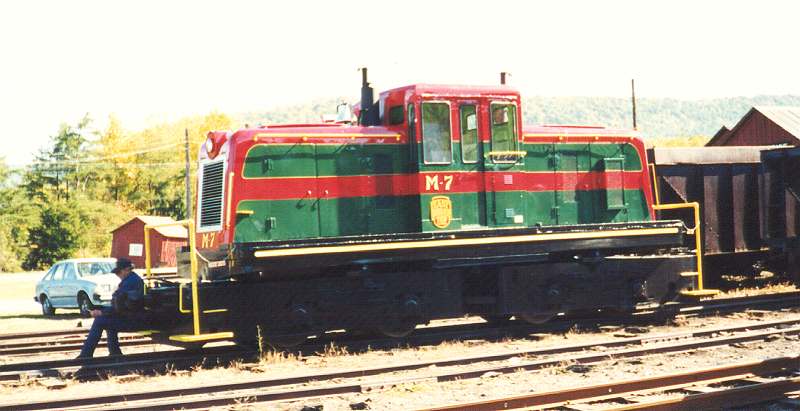
After the railroad reopened as a tourist attraction in 1960, management acquired a collection of 16 different gas or diesel locomotives.  Only eight of them were actually used in service; the rest were stored on the property and disposed of over the years.  Until the end of tourist operations two years ago, trains were hauled either by 2-8-2 #15 or by GE 55 ton diesel electric M-7.  Several smaller diesels are still in occasional use for shifting in the Rockhill yard.  Here is a photo of the M-7 in operation.


So maybe my idea of an EBT diesel wasn't such a wild idea after all!  Upon inspection, I found that the only glaring problem was the Boston & Maine logo on the center cab.  I brushed on a small puddle of Solvaset, let it sit for a minute, and then began to work the logo with a wooden toothpick.  To my surprise and delight, the logo began to soften and come off.  It was a decal!  Careful work with several applications of Solvaset and rubbing gently with a toothpick resulted in the complete removal of the logo.  I then applied an EBT "acorn" logo from a set of steel hopper car decals, applied a coat of Microsol to settle it onto the cab surface, then sprayed the entire unit with Dullcoat.  The result was an engine that bore a fair resemblance to the M-7.


The EBT generally numbered their diesels with the prefix "M", but I argued that this diesel was recently acquired used from the Boston & Maine, and the railroad opted to leave it as number 118 for the time being. 

The next issue was converting the locomotive from DC to DCC.  The Bachmann engine has a small printed circuit board on top of the motor frame.  This acts as a constant lighting control for the front and rear 12 volt bulbs.  The unit has all wheel pick-up, which is ideal for DCC, expecially with such a small engine.  I carefully detached the printed circuit board from the frame, and disconnected the wires running to it.  They were clipped to the PC board, rather than soldered, which made it easy to separate the wires for each truck (using an ohm meter to determine which wire went to which side), the wires to the motor, and the wires to the lights.  I carefully tagged each pair of wires with tape.


Rummaging through my box of decoders, I found a Soundtraxx MC1Z102SQ 2 function decoder that was no bigger than my thumbnail.  The Z in the model number is a dead giveaway.  You can see from the above photo that the tiny decoder fits right on top of the frame, leaving plenty of room for the shell to fit on top.  I connected the wheels to the red and black decoder wires, then the motor to the orange and gray leads.  A quick test on the layout showed no problem running forward and back.  I then ran the white wire to the headlight and the yellow wire to the backup light.  The blue decoder wire is the common for lighting, and was connected the the other side of the front and rear bulbs.  An engineer from my scrap box completed the effect.


So there you have it.  A $20 EBT standard gauge diesel shifter perfect for shunting cars around the Blacklog Refractories brickyard.


This was a fun project that took a couple of evenings and adds some interest to the dual gauge operations at Blacklog.


Sunday, September 1, 2013

Blacklog Refractories Corporation (BREFCO)

In my previous post, I described the thriving Mount Union industries manufacturing firebrick for the steel furnaces of Pittsburgh and Steelton, Pennsylvania.  On my HO scale layout, the bustling town of Blacklog is modeled after Mount Union, and like its larger cousin to the north, includes both a coal cleaning plant and a brickyard.  Mount Union was home to North American Refractories (NARCO) and General Refractories (GREFCO), as well as the Harbison-Walker plant on the west side of town.  Blacklog is the home of Blacklog Refractories Corporation, or BREFCO, which occupies a significant space on one end of the layout.  Here is a picture of the plant, with the dual gauge yards and coal cleaning plant in the background, and the town of Blacklog on the right.


As you can see, the plant includes a conveyor from nearby Blacklog Mountain, which carries ganister rock from the quarry to the crusher on the left.  Additional ganister is brought in by rail below the conveyor.  The crushed rock is then carried by another conveyor to the two story brick building with its brick smoke stack, where the rock is mixed with water and moulded into bricks for firing.  The six kilns on the right are served by dual tracks to bring in coal for firing the ovens.   To the right of the kilns are a series of wood and metal buildings designed to warehouse the finished bricks until they can be carried off by boxcars.  The curved track in the foreground is the mainline of the Blacklog Valley Railroad, a standard gauge pike that shares the dual gauge yards in the left background.  If you look carefully, you might noticed three identical houses just beyond the plant.  These are modeled after actual GREFCO company houses along the EBT tracks in Mount Union.  Below is another view of the company houses with the warehouses on the right and the mountains in the background.


As I mentioned in my previous posting, the ground cover in the brickyard industrial area is #180 Sandstone, sanded grout from Polyblend, available at your local hardware or building supply store.  I first read about Polyblend in Bob Brown's "Ramblings" in the January/February 2010 issue of the Narrow Gauge and Shortline Gazette.  I had been waiting for an opportunity to try out this new ground cover material, and the brickyard seemed the perfect choice.  Bob had tried mixing the grout with water and brushing it on, but I tried spreading the grout and spraying with a fine water mist.  The misting worked well enough, but tended to get everything else on the layout just as wet (I should have used a plastic drop cloth, but hindsight is 20/20, right?)  I then tried brushing on diluted matte medium and sprinkling grout over it.  This also worked, but tended to produce clumpier and darker areas on the terrain.  I also used matte medium on piles of grout at the end of the stub sidings to build up end of the track bumpers, which came out very well.


The kilns in the photo above are plaster castings that were painted and colored with grimy black weathering powders.  The rusted metal bands holding the bricks together were painted onto the kilns using a Prismacolor dark umber marker.  I ran across the idea of using Prismacolor markers from Michael Duggan, owner of Paw of a Bear Models in Virginia.  The markers did color the bands as I had hoped, but it was hard to keep a straight line freehand.  At first, I was sure I had ruined the model, but after weathering with powders, and viewed from a distance, the less than perfect lines vanished in the distance (see above).


Clearly, the production of bricks requires more than crushed stone and kilns.  The stone has to be combined with water into a slurry, formed into moulds with the required shapes, and dried before firing.  Between the crusher and the kilns I chose to place a "mould house", using the Easton Mill kit by RDA (Railway Design Associates) out of Monson, Massachusetts.  This was a traditional northeastern brick mill building, with a large brick smoke stack at one end, and a conveyor belt from the crusher at the other.  I used white water color and a wetting agent to flood the gaps between bricks on the mill walls, to resemble mortar.  Half of the RDA roof was missing from the kit, so I replaced the kit's roof and its cupola with Evergreen corrugated metal.  To disguise the seams between sections of the kit, steel wire was shaped into downspouts, while Evergreen channel was used for gutters.  The results, including the BREFCO logo on the smoke stack, were exactly what was needed.


Here is another view of the building in place on the layout.


There are still a number of details to be added to the BREFCO  brickyard, including ballasting of the tracks outside the yard, adding weeds and shrubs around the major structures, along with a company water tower (complete with BREFCO) and a "burial ground" for broken and castoff bricks.  All of this remains to be added before I can call the Blacklog brickyard finished.


Sunday, August 25, 2013

Building a Brickyard

The town of Mount Union marked the northern terminus of the East Broad Top narrow gauge railroad and its junction with the Pennsylvania Railroad. While Broad Top coal was one reason for the town's importance, it was not the only local industry. Mount Union was also home to three large brickyards, or refractories, where ganister rock (a mineral found in several locations along the EBT) was quarried, crushed, and made into high temperature firebricks for the steel mills of Pittsburgh.  In their heyday, North American Refractories (NARCO), General Refractories (GREFCO) and the huge Harbison Walker plant employed thousands of workers and were a primary source of employment for the citizens of Mount Union and the surrounding area.   Here is an early post card view of the Harbison Walker refractory in Mount Union.


The Harbison Walker facility was located at the foot of Jack's Mountain, seen in the background, a major source of ganister rock on both sides of the Juniata River.  The huge size of the refractory is best seen from an aerial view.  Below you can see the long rows of kilns, where the yellowish bricks were fired at high temperatures, and the associated smoke stacks to vent off the heat and smoke from the fires. In the early days, kilns were fired with coal or coke.  Toward the end of its existence, H-W had made the transition to natural gas, which was plentiful, cheap, and less toxic than coal.  The tracks in the foreground are dual gauge for the EBT and the PRR. 


Across town, North American Refractories, or NARCO, was located on the banks of the Juniata and was served by a spur of the PRR.  On the lower left, below, you can see the roofs of standard gauge boxcars in which the newly fired bricks would be shipped out on the Pennsy to steel mills east and west.


When I began to plan my own layout, I knew that I wanted to include a smaller version of these bustling industries.  The town of Blacklog, with its dual gauge yard and coal cleaning plant, was modeled after Mount Union.  So it seemed reasonable that Blacklog include a brickyard as well.  I had explored the hills around the Harbison Walker plant when I lived in Mount Union, and I knew I wanted my brickyard to resemble a miniature version of that facility.  I was inspired by a close-up view of the refractory in a photograph provided by the Mount Union Area Historical Society.


I particularly wanted to reproduce the complexity of the brickyard, with conveyors bringing ganister rock down from the quarries on Jack's Mountain, the large crusher to the left center, the kilns and stacks in the background, and the variety of structures, roofs, and building materials in the photograph.

For the crusher, I used a Walther's Glacier Gravel plant kit, 933-3062, which would be connected to quarries on a nearby mountainside by combining several of the Modern Conveyor kits (933-3518).  Here you can see the crusher on the left, served by two tracks.  The Blacklog Valley main line runs under the conveyor as it loops back around the town.  The mountain on the right was made of layers of 2 inch pink foam insulation, stacked to suggest receding terraces from years of quarrying ganister from the mountainside.  In the lower right corner is the dual gauge EBT wye. 


An Easton Mill building by Railway Design Associates would be added later to provide a place for shaping and preparing the firebricks for the ovens.  There would also have to be several large warehouses to hold the finished products for shipment.  All of this would need at least five industrial spurs to service the plant.  Here I am laying out the brickyard to get a feel for how it might look.


While most of the structures in the refractory were commercially available for kitbashing, I was at a loss as to how to model the kilns.  At first I was attracted to the wonderfully detailed resin kilns from Model Railstuff (Walthers 506-660) with massive matching stacks (506-680).  But after spending more than $75.00 for one kiln and stack, I started looking for an alternative.  After more than a year of searching, I stumbled over a set of cast plaster kilns on eBay from Imported Specialties out of Columbus, Ohio, which were about a third the price of the resin models.   The plaster kilns were pure white.  The following photo shows one of the kilns after spraying wiyth Model Master 1963 Desert Sand.  The paint was as close as I could get to the color of the kilns and stacks at Mount Union.


Apparently, the maker of these kilns no longer exists; but eventually I was able to accumulate a total of six kilns on eBay, some of which had been broken and glued back together.  Still, beggars can't be choosers, and I felt that when painted and weathered, the cracks would hardly be noticeable.  That turned out to be correct, as you shall see in the next post, when I continue the story of how I built the Blacklog Refractories Company, or BREFCO for short.